Effective Management of Artavakshaya w.s.r to Oligo-hypomenorrhea through Ayurveda Regimen: A Case Study
Clinical Case Study
DOI:
https://doi.org/10.64280/JAA.2025.V1I1016Keywords:
Artavakshaya , Artavadushti,Oligo- hypomenorrhea, AgneyaAbstract
Introduction
Menstruation is the act of nature and important part of woman’s life that occurs as a regular rhythmic period and remains as a normal physiological The journey from menarche to menopause involves continuous cyclical changes, and any deviation in the normal quantity or duration of menstrual flow—with or without associated pain—can be linked to conditions such as Vātaja raja-duṣṭi, Kṣīṇārtava, or Ārtava-kṣaya. In these situations, Vāta and Kapha cause mārga-āvaraṇa, which obstructs the natural passage of Ārtava and results in its depletion. Since Ārtava possesses an agneya quality and is primarily governed by Pitta dosha, the specific causative factors for Ārtava-kṣaya can be understood as those that aggravate Vāta-Kapha or lead to Pitta depletion.
Methodology
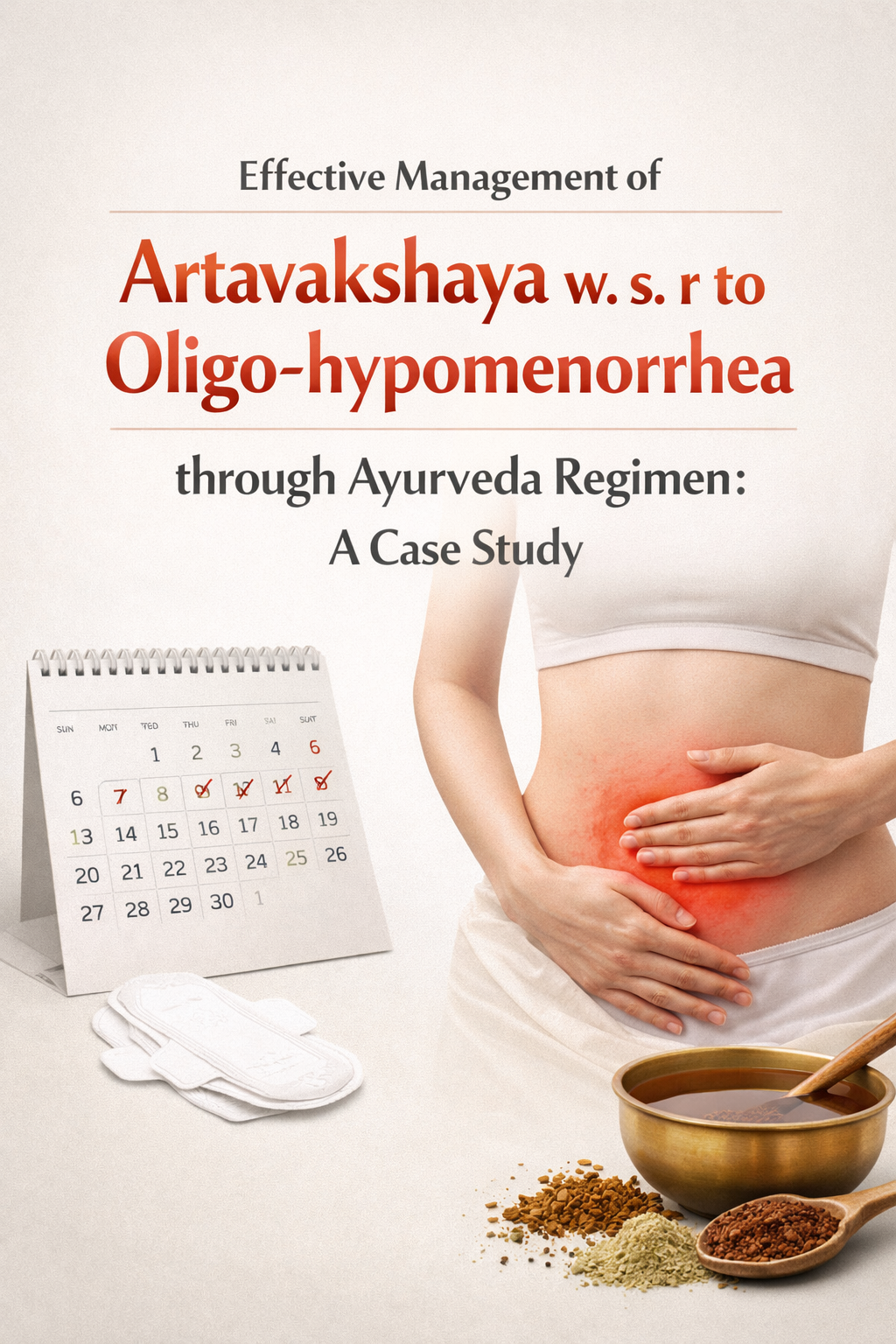
A 26-year-old woman visited the OPD at PLRD Hospital, Khurja, on 27/10/2024 with the primary complaints of scanty and delayed menstrual cycles. For the past three years, her periods had been occurring every 40–45 days, with menstrual bleeding lasting only 2–3 days. She also reported moderate dysmenorrhea, which was evaluated using the Visual Analogue Scale. The patient underwent treatment with Laśuna Kalpa for two successive cycles, considering its agneya, srotoshodhaka, kapha-vāta–śāmaka, pitta-vardhaka, and vāta-anulomaka actions. After completing the therapy, she was observed for one additional cycle without medication.
Result and Conclusion
The patient had regular menstruation with normal duration and interval, with an adequate amount of menstrual flow and the intensity of pain was reduced effectively from moderate to mild. Even after cessation of medicine, she got her menstruation in 30 days with a normal amount of flow.
Downloads
Published
Issue
Section
License
Copyright (c) 2025 The Author(s)

This work is licensed under a Creative Commons Attribution-NonCommercial-ShareAlike 4.0 International License.