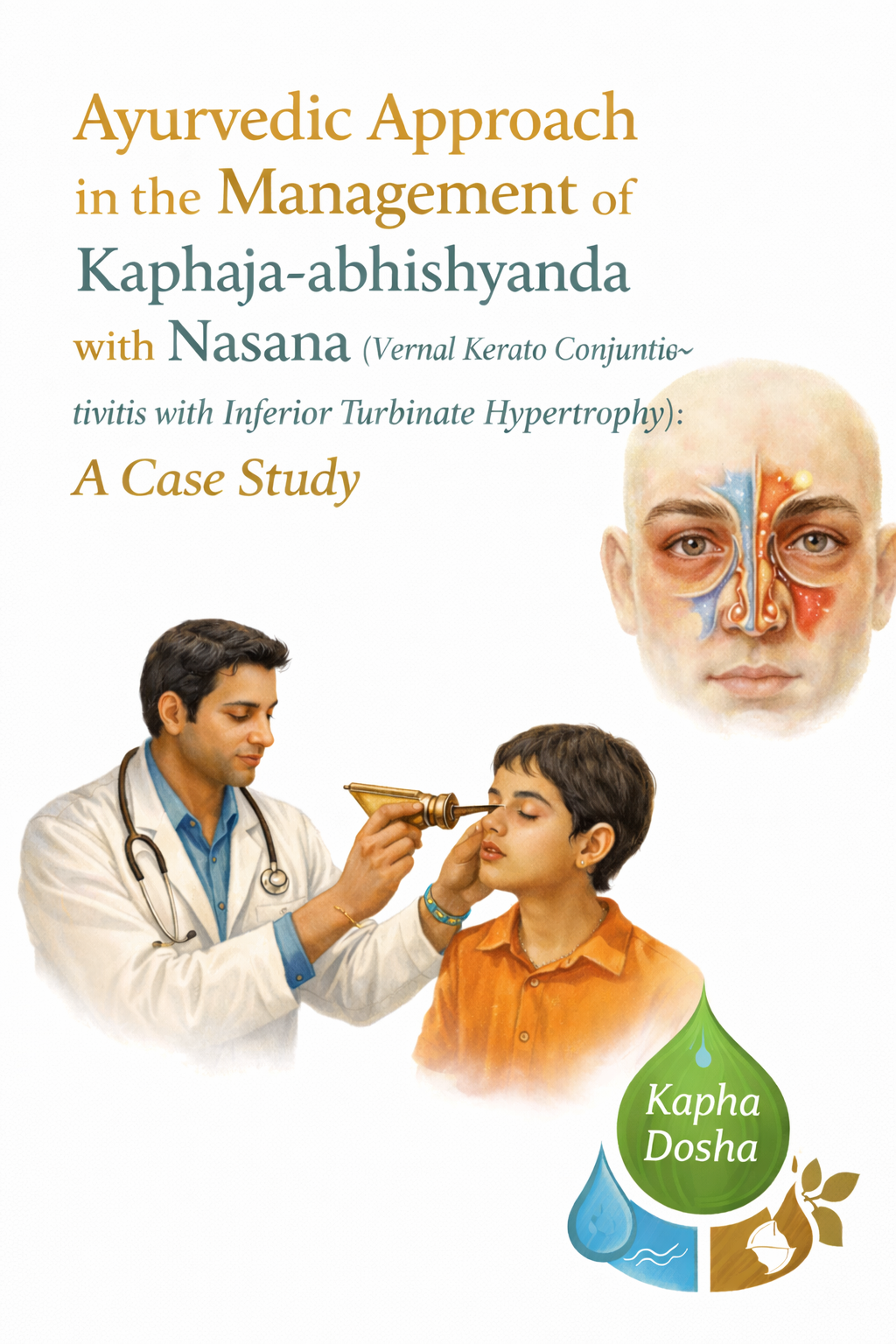
Ayurvedic Approach in the Management of Kaphaja-abhishyanda with Nasanaha (Vernal Kerato Conjunctivitis with Inferior Turbinate Hypertrophy): A Case Study
Clinical Case Study
DOI:
https://doi.org/10.64280/JAA.2025.V1I1013Keywords:
Case report on Kaphaja Abhishyanda, Ayurvedic treatment of VKC, Kaphaja Abhishyanda, Yashtimadhu Ksheerapaka Netrasheka, Netrasheka.Abstract
Introduction: Abhishyanda are of four types and Kaphaja Abhishyanda is one among them. The sign and symptoms of Kaphaja Abhishyanda is like the sign and symptom of Vernal Kerato-Conjunctivitis (VKC). In this condition, the antihistamines and steroids are the drug of choice. In Ayurveda, these conditions are treated with Lekhana and Kapha-Pitta Shamaka Upakrama in the form of Netrasheka, Aschyotana, Anjana, Nashya, Raktamokshyana and Shamana Aushadhi.
Patient information: A 4.6-year-old male child having intense eye itching, photophobia, dusky eyes, watering of eyes came to our OPD with his parents for Ayurvedic treatment. The patient had bilateral inferior turbinate hypertrophy, and he was a case of mild Deviated Nasal Septum (DNS), he also had dried with itchy skin.
Material and Methods: Considering the case as Kaphaja Abhishyanda, we managed the case with Netra Kriyakalpa (~Topical Ayurvedic ocular therapy), Pratimarsha Nashya, and Kapha-Pitta Shamaka Aushadhi (~Conservative treatment).
Results: After seven days of treatment, the eye became clear. The photophobia, congestion, size and number of Trantas spot reduced. The gelatinous ring faded. Grossly speaking there is improvement in the patient’s eye. The dryness, itching of skin and nasal congestion was also reduced.
Conclusion: The sign and symptoms of the VKC eyes are effectively treated with Netra Kriyakalpa and Shamana Aushadhi. The Netrasheka, Anjana, Nashya, and Kapha-Pitta Shamaka treatment can be an effective alternative of the antihistamine and steroidal eye drops in VKC.
Downloads
Published
Issue
Section
License
Copyright (c) 2025 The Author(s)

This work is licensed under a Creative Commons Attribution-NonCommercial-ShareAlike 4.0 International License.